The Things We’re Still Letting Go OF
We have a storage unit in Bend that we have been paying for since April of 2025.
Fourteen months. Most of what we owned went through it at some point — sorted, kept, sold, or given away in the great unraveling that became this blog. The big things went first and fast in Arizona. The bed. The TV. The dining set. The furniture that takes up the most space and means, somehow, the least. Selling those felt almost mechanical. Practical. Easy in a way I didn't expect.
What's left is smaller. And it's harder.
What's Still There
The food processor. The Vitamix. Two bookshelves in the office, still full. Clothes. Artwork. Knickknacks we love. Smaller things we ran out of time to deal with the first time through, or weren't ready to part with, or are still actively using because we are, after all, still living here while we figure out the rest of this.
The timeline shift bought us something unexpected: enough time to actually go through everything properly instead of in a panicked rush toward a flight date. We are emptying that storage unit now, slowly, to stop paying for space we don't need to be paying for.
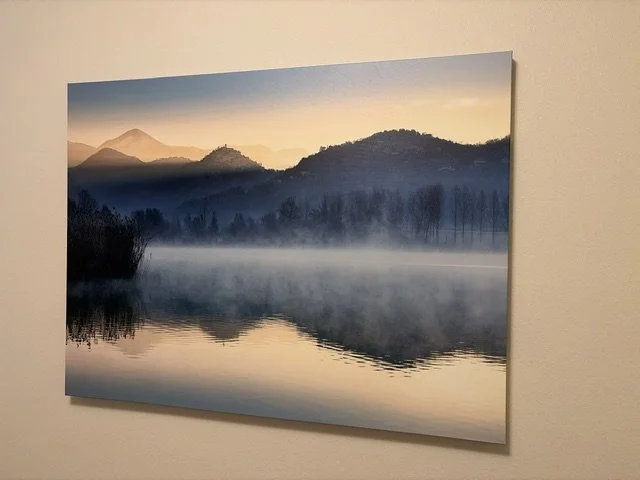
And in doing that, we've been giving a lot of it away. To our family — two nieces and a nephew, all in their twenties, all genuinely happy to take what we no longer have room for. The large artwork, gifts from Kelly. The blue hammock from Mexico. My mirrored necklace holder. Even the paper towel holder, the one I am unreasonably fond of for reasons that make sense to no one. All of it has already walked out the door into someone else's home.
The Heart Tug
I want to be honest about something, because this blog has never been about pretending things are easier than they are.
It is wonderful that they want our things. It really is. I am thrilled every time something we loved walks into a life that will keep using it, keep loving it, instead of sitting in a storage unit accumulating a monthly fee or selling to a stranger.
And also: I felt it every single time. Some pulled harder than others. The artwork pulled. The hammock pulled. Watching the necklace holder go was surprisingly tender. None of it was unbearable, but none of it was nothing either.
We are not giving away things we dislike. We are giving away things we love. The reason they're going is not that we've fallen out of love with them — it's that we cannot take it all, because it's too expensive, and because much of what we own simply will not work once we're living under a different electrical system. I'm not attached to the toaster. I won't miss the toaster. But the Vitamix and the food processor are a different story entirely, and those are the ones giving me real pause.
Here's why. The United States runs on 120 volts. England runs on 230. It isn't a small difference — it's nearly double — and it means all of our small kitchen appliances, built for American current, simply won't function safely on British power. The voltage doesn't negotiate, no matter how attached I am to what plugs into it.
Kelly is better at this than I am. He's mostly ready to let things go and doesn't carry the same weight I do watching them leave. I am the one who holds on a little tighter, a little longer. I always have been.
Two Tools That Actually Mattered
I want to linger on the Vitamix and the food processor specifically, because they aren't sentimental in the way the hammock is sentimental. They're sentimental because of what they've actually done for me.
Since being diagnosed with RA, my diet has become a real and constant part of how I manage this condition — the anti-inflammatory eating, the whole foods, the elimination of so much of what used to be easy and convenient. That requires a lot more food prep than I ever used to do. Chopping, blending, processing, building meals from scratch nearly every day instead of reaching for something quick.
The Vitamix has made that possible in a way I don't think I fully appreciated until I sat down to write this. Countless smoothies. Whole vegetables and fruit, blended down into something my body can actually use well. The food processor has done the unglamorous, repetitive work of prep that would otherwise eat hours out of every week. Due to the pain and now permanent damage in my hands, wrists and fingers, I am often unable to chop vegetables without pain. Kelly of course has stepped in to handle the prep as well, but these tools have been vital to us in this journey. These two machines have quietly supported my healing in a very literal, physical sense, almost every single day.
So when I say I'm holding onto them a little tighter than the rest, it isn't really about the appliances. It's about what they represent — the tools that have helped me learn how to take care of this body in its new reality.
An Inanimate Object, and Also Not
I started collecting vinyl in my twenties. It isn't a massive collection by any serious collector's standard, but it's been decades in the making, and it represents a version of my life I can trace through the records themselves — what I was listening to, who I was becoming, what got me through what.
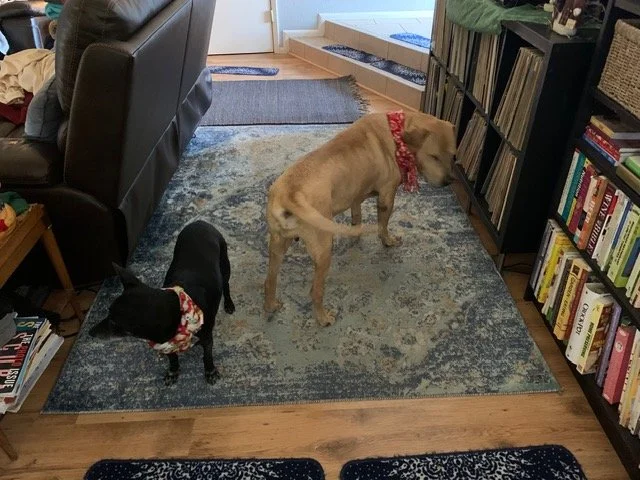
Mollie and Samson
And the books. The books I get the most attached to of all.
My shelves are a strange and honest map of who I am. The self-help and the spirituality books. The rock biographies and memoirs. The fiction that quietly shaped me over years I didn't realize I was being shaped. I feel better when they're around me. I have learned actual, real things from every one of them, and somehow the physical presence of the book still matters to me even after the learning is done.
Walking into a bookstore, my whole body relaxes. I can lose hours in there. I have spent hundreds, probably thousands of dollars over the years on books, to the point that Kelly has learned to give me a time limit and a budget before we walk in, because otherwise I simply will not stop. (He's not wrong to. I've tested this theory many times.)
So the books and the music are staying with me. That part isn't up for negotiation.
The Stuffed Animals Had to Breathe
I think this is part of being what they now call a highly sensitive person, though nobody had that language for me when I was small.
As a kid, I genuinely believed my stuffed animals were alive in some sense. I made sure they were never piled on top of each other, because they needed to be able to breathe. I lined them up at mealtime and made sure every single one got fed. I have always felt that things carry meaning. That everything is valuable in some way that isn't always rational or explainable to the people standing next to me, watching me take this much care over a stuffed rabbit or a chipped mug.
I baffled adults with this as a kid. I still occasionally baffle adults with it now. But to me it has always felt as natural as breathing. I choose what comes into my home and my personal space thoughtfully, deliberately, because those things are not just objects to me. They're part of how I build a sense of safety around myself.
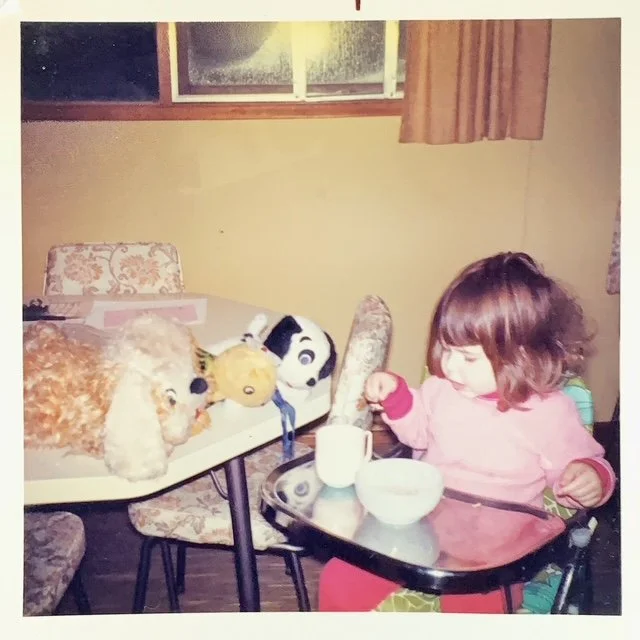
Lainie feeding her babies 1973
What We're Shipping Instead of Selling
As we've started researching what it actually costs to ship things abroad, something has shifted in how we're approaching what's left.
We're holding off on selling certain things until we have a clear picture of what's actually possible and what it will cost. The practical things first: our pots and pans, the good kitchen knives, books, the vinyl collection. We had already planned to keep the books and records in storage here in the States. But now that we know we'll have a real, solid base in England from the start rather than a tentative six-month tourist stay, shipping some of it instead of storing it indefinitely is starting to look like the better choice.
It's funny what you can get attached to. They're inanimate objects. I know that. And also, they're not just that, not to me.
What Other People's Blogs Taught Me
While researching this move, I've read through other people's stories — others who made this same leap, who sold what they owned and moved to a different country to build something new. A pattern showed up again and again in what they wrote afterward.
People were either deeply grateful they'd brought certain personal items with them, or they deeply regretted leaving them behind.
It makes sense when I sit with it. Even moving somewhere that speaks the same language, the culture is different. How people talk, what they value, the rhythm of daily life — all of it shifts under your feet in ways you can't fully predict from the outside. The people who wrote about this said the same thing in different words: having a few things that felt like home made the hard days easier. Gave them something steady to hold onto when everything else around them was unfamiliar.
I already know I'm going to be one of those people.
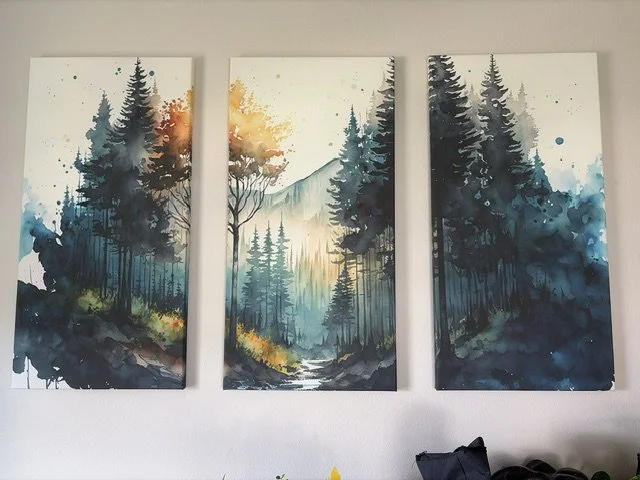
I am genuinely excited to build a new life with new things — to curate a new space slowly and intentionally, the way I always have, and watch it become its own thing over time. That part of this is one of the things I'm most looking forward to. But I also want a foundation. A few things that are unmistakably, recognizably me, sitting in whatever room becomes ours next, so that on the hardest days — and there will be hardest days — I have something to anchor to.
The vinyl. The books. The smaller artwork. Those are coming with us.
We are letting go of so much. We have to. But not all of it. Not the parts that are actually, quietly, still holding us up.
I have been thinking a lot about this — the objects and spaces and practices that create genuine felt safety in the nervous system, and why some things hold us up in ways we cannot always fully explain but can absolutely feel. It connects directly to the work I do at Field & Frequency, where the science of nervous system regulation meets the very human experience of building a life that your body can actually rest inside.
If that intersection interests you, come find me there.
Find us on Etsy: Coming Soon
